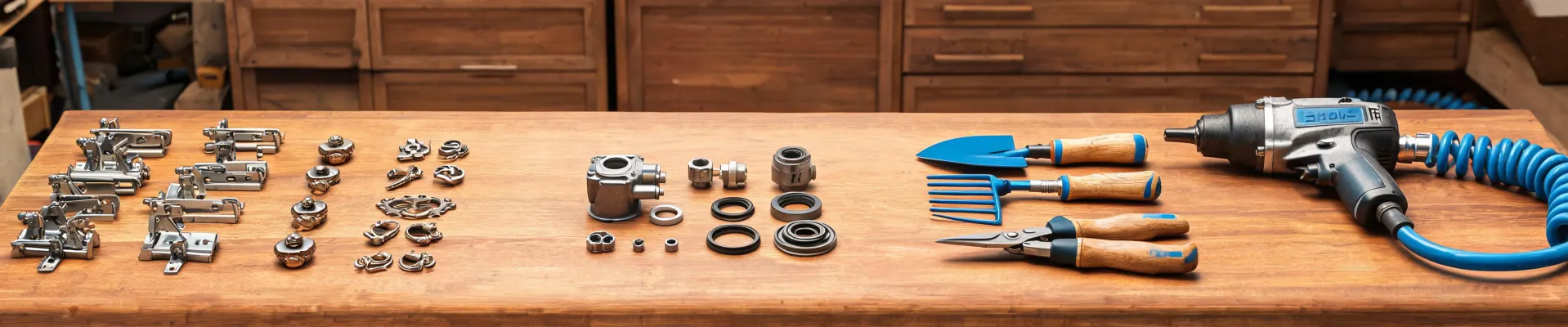
Professional vs. General-Purpose Fastening: A Spec-First Comparison for Buyers Who Hate Rework
-
What I'm Comparing, and Why It Matters Before You Spend a Dollar
-
Dimension 1: Anchor Choice—Purpose-Matched vs. Generic Fastener
-
Dimension 2: Fastening Tools—Dedicated Screw Gun vs. Ratchet T-Handle vs. Drill Driver
-
Dimension 3: Cordless Drill Specs—What to Look For in a Cordless Drill for DIY vs. Professional Use
-
Dimension 4: The Verification Step—Check Before vs. Correct After
-
So Which Approach Should You Choose?
What I'm Comparing, and Why It Matters Before You Spend a Dollar
I review deliveries for a living. Roughly 200 unique items a year come across my desk before they reach a job site or a customer—and in 2023, I rejected about 18% of first deliveries because something didn't match the spec sheet. That number used to be higher. The lesson that keeps repeating itself: the cheapest moment to catch a mismatch is before the purchase order goes out.
So this isn't a review of brands. It's a comparison of purpose-matched specification versus general-purpose assumption—across four dimensions I check every single time: anchoring system selection, fastening tool choice, cordless drill criteria, and the verification step most buyers skip. If you're specifying a Hilti system or a generic fastener, the framework is the same. The question isn't which one is "better." It's which one actually matches the job, and whether you verified that before ordering.
Dimension 1: Anchor Choice—Purpose-Matched vs. Generic Fastener
Here's the comparison that trips people up. A Hilti Kwik Hus EZ screw anchor and a plain interior binding post screw are both "fasteners." They are not interchangeable, and if you've ever tried to source one to do the other's job, you know exactly what I mean.
The Kwik Hus EZ is a screw anchor designed for concrete and masonry—installed with a screw gun, torqued to a defined value, and load-rated against a published standard. A plain binding post screw is an interior furniture/assembly fastener; it's a fine product for its application, but it carries no concrete load rating because it was never meant to. Comparing them directly is a category error. The real comparison is between selecting the fastener that matches the substrate and load versus selecting whatever's closest on the shelf.
In Q1 2024, we had a batch of 400 anchors come in where the embedment depth ran about 3 mm short against our specification. Normal tolerance on that spec is ±1 mm. The vendor's reply was that it was "within industry standard." It wasn't within ours. We rejected the batch, and I now write the embedment depth, torque value, and applicable standard (ETA or ICC-ES evaluation, depending on region—verify the current report with the manufacturer) into every PO. A generic fastener doesn't give you a spec sheet to hold it against. That's the whole point of going purpose-matched: you get something you can verify.
Dimension 2: Fastening Tools—Dedicated Screw Gun vs. Ratchet T-Handle vs. Drill Driver
This is where my initial thinking was flat wrong. When I started in this role, I assumed a drill driver could do anything a dedicated fastening tool could do. Six torque-stripped anchors later, I understood why that's not true for production work.
A screw gun (the Hilti platform is the one our crews standardize on, though the principle applies broadly) is built for repeatable depth and torque control when driving anchors and screws. It has a clutch and depth stop tuned for that job. A ratchet T-handle is the opposite end of the spectrum—manual, high-leverage, and great when you need controlled feel and no power source, like in tight overhead spots or where a battery tool is awkward. A standard drill driver sits in between: flexible, but the least repeatable of the three for anchor setting.
So the honest comparison isn't "which tool wins." It's throughput and repeatability (screw gun) vs. control and access (ratchet T-handle) vs. general flexibility (drill driver). If your crew sets 200+ anchors a day, the screw gun pays for itself in consistency. If you're doing 10 in an awkward ceiling corner, the ratchet T-handle is the smarter reach. Specifying the wrong one is a process gap I made twice before I built a simple tool-selection line into our pre-order checklist.
Dimension 3: Cordless Drill Specs—What to Look For in a Cordless Drill for DIY vs. Professional Use
This is the dimension where the surprises live, because the criteria most people research for DIY are not the criteria that matter in professional verification—and vice versa.
If someone asks me what to look for in a cordless drill for DIY, I tell them to weight comfort, battery platform compatibility, and warranty coverage. Those are the three things that decide whether a homeowner actually uses the tool. Torque specs on paper rarely matter at that level.
For professional use, the order flips. What I verify is: rated torque under load, chuck runout, clutch repeatability, and whether the manufacturer publishes service intervals and spare-part availability as of a specific date. I'll check the current datasheet rather than a spec from a review site—ratings get revised, and I've seen a 2024 datasheet list a slightly different no-load speed than a 2022 version for the same model line.
The counterintuitive conclusion: the DIY buyer and the professional buyer should be reading completely different spec sections of the same product page. Same tool, different verification priorities. Buying "the professional one" for home use usually just buys weight and cost you don't need.
Dimension 4: The Verification Step—Check Before vs. Correct After
This is the comparison that ties the other three together, and it's where prevention beats correction every time. On one side: a 15-minute spec check before the order. On the other: 5 days of rework after a bad delivery lands.
I know the number because I paid for the lesson. In 2022 we took delivery of an order where a bearing post dimension was visibly off—measured 24.5 mm against a 25.0 mm spec, with a normal tolerance of ±0.2 mm. The batch had already been assembled into finished units before anyone checked. That quality issue cost roughly $22,000 in redo labor and pushed a customer launch back a week. The fix was a 12-point verification checklist I wrote in about an hour. It's saved an estimated $8,000 in potential rework since, just by forcing us to confirm spec, quantity, and standard before we accept.
Blockquote-worthy, in my opinion: 15 minutes of verification beats 5 days of correction. That's not motivational—it's arithmetic.
So Which Approach Should You Choose?
Since the whole point is helping you decide, here's the scenario split rather than a single verdict:
- If you're setting anchors in concrete on a production schedule: go purpose-matched (Kwik Hus EZ-class anchor) and drive it with a dedicated screw gun. The upfront cost buys you a spec sheet you can verify and a torque value you can hold a vendor to.
- If you're doing low-volume, awkward-access fastening: a ratchet T-handle plus a general drill driver is often the more sensible, lower-cost match. Don't over-spec for the job.
- If you're a DIY buyer choosing a cordless drill: prioritize comfort, platform, and warranty. Ignore the torque bragging on the box unless you're actually driving into masonry.
- If you're specifying for a team: build the verification checklist first, before you order anything. The checklist is the cheapest insurance you'll ever write.
Wherever you land, write the spec down. A generic fastener and a purpose-matched one look the same in a bin until someone checks the dimensions—and by then, the rework clock is already running.
Note: Product specifications, ratings, and standards referenced here should be verified against the current manufacturer datasheet and applicable evaluation reports (e.g., ETA or ICC-ES) before purchase. Specifications are revised periodically; what was accurate for a 2023 order may not match a 2025 datasheet.

Helena Duarte
Helena Duarte is an independent pipe, valve, and pump applications analyst covering fittings, ball valves, gate valves, check valves, butterfly valves, flanges, hose clamps, centrifugal pumps, sump pumps, and submersible pumps. She uses ISO 5208 pressure-testing concepts and ISO 9906 pump acceptance methods while comparing pressure class, seat leakage, Cv, head, flow, efficiency, solids passage, seal materials, and installation orientation. Her guides help specifiers and maintenance teams match fluid-handling components to service conditions and acceptance criteria.